
Topics in this issue of Behind the Blue:
- From the Chair: New Report Unpacks the Blueberry Industry’s Powerful Influence on the Economy
- USHBC Team Presents at Congreso Internacional Anneberries
- Study Finds Swapping Common Fruits for Berries in USDA’s Dietary Patterns Improves Nutritional Benefits
- USHBC Team Attends School Nutrition Association Conference
- BerrySmart Fields Days Highlight Industry Innovation
- MRL Quick Reference Sheets Now Available to Assist American Produce Exporters
- 4 Reasons The Blueberry Convention Is Not to be Missed!
- Leadership Class Spotlight: Meet Sergio Carrasco
From the Chair: New Report Unpacks the Blueberry Industry’s Powerful Influence on the Economy
By Bryan Sakuma
USHBC Chair
To help celebrate and bring awareness to the value our growers bring to the economy and their communities during National Blueberry Month, the USHBC released an in-depth economic impact report, along with supporting infographics and fact sheets. The report shows blueberry growers and importers deliver a powerhouse crop that contributes nearly $9.1 billion in annual economic impact to the U.S. economy, or nearly $25 million every day.
And it helps prove that blueberries aren’t just a boost of health, but a valuable boost to the economy, underscoring the extent to which the industry stimulates business activity, creates jobs and contributes mightily to the country’s financial landscape.
In addition to the national report, state- and country-level reports are also available.
Commissioned by the USHBC, the study was conducted by Dennis Tootelian, Ph.D., emeritus professor of marketing and former director of the Center for Small Business in the College of Business Administration at California State University, Sacramento. The analysis is based on U.S. highbush blueberry acres in production and in development, as well as spending by companies that are importing blueberries. Projections are based on annual average expenditures, which means that this impact is expected to occur each year that such spending occurs. National acreage statistics were secured from the U.S. Department of Agriculture.
I encourage you to check out all the reports on the USHBC website, and share the information with your network and your community. It’s impressive – and now’s a great time to spread the word about our impact.
USHBC Team Presents at Congreso Internacional Anneberries

A USHBC staff delegation attended the Congreso Internacional Anneberries July 23-24 in Guadalajara, Mexico. USHBC also hosted a booth at the event.
USHBC President Kasey Cronquist participated in a roundtable discussion titled “Berries Without Borders: The Global and Integral Approach of International Organizations.”
USHBC Vice President of Global Marketing and Communications Kevin Hamilton gave a presentation titled “Driving Growth: Promotional Strategies and Campaigns for the Blueberry Market in Mexico and Worldwide.” Also attending was Director of Global Business Development Haiying Zhang, as well as Vice President of Engagement and Education Amanda Griffin and Industry and Community Engagement Manager Mandy Boarman who spread the word about the importance and value of NABC membership.
Study Finds Swapping Common Fruits for Berries in USDA’s Dietary Patterns Improves Nutritional Benefits
A new study published in Annals of Medicine, and co-authored by USHBC’s own Senior Director of Nutrition and Health Research Leslie Wada, Ph.D., shows that replacing a serving of commonly consumed fruit (apples, bananas or grapes) with a serving of berries in USDA’s Dietary Patterns significantly increased an individual’s intake of beneficial nutrients, namely anthocyanins, vitamin C and fiber – all of which are associated with lowering the risk of cardiovascular disease – without changing overall calories or macronutrients.
Food pattern modeling of Healthy U.S.-Style (HUS), Healthy Mediterranean-Style (HMS) or Healthy Vegetarian (HV) United States Department of Agriculture (USDA) dietary patterns demonstrated that when one cup of common fruits (apples, bananas or grapes) is swapped for one cup of berries (blackberries, blueberries, raspberries and strawberries) daily …
- Anthocyanins increased by 93.8%
- Vitamin C rose up to 16%
- Soluble fiber increased by up to 10.2%
- Total sugars and carbohydrates decreased slightly
- No change in overall calories or macronutrients
These findings highlight berries’ unique nutrient profile – particularly their high anthocyanin content – and support considering fruit subgroups in dietary recommendations, similarly to how vegetables are classified by type and color.
Despite the known benefits of fruit, National Health and Nutrition Examination Survey (NHANES) data shows that most U.S. adults only eat one fruit per day, usually bananas, apples or grapes. Encouraging individuals to consume a variety of fruits, especially berries, may improve their dietary quality and lower their risk of cardiovascular disease.
Learn more about the study by reading our press release.
USHBC Team Attends School Nutrition Association Conference
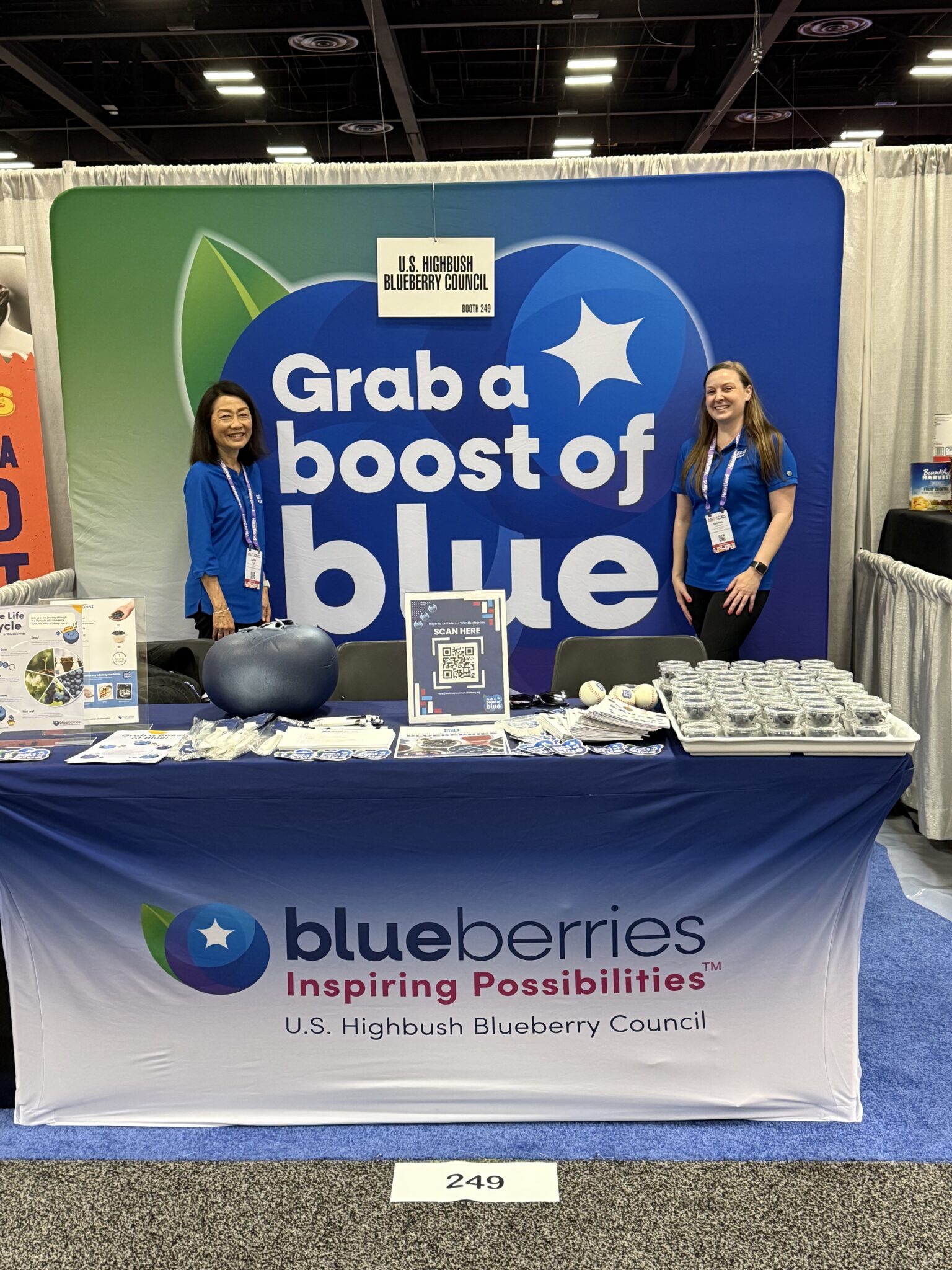

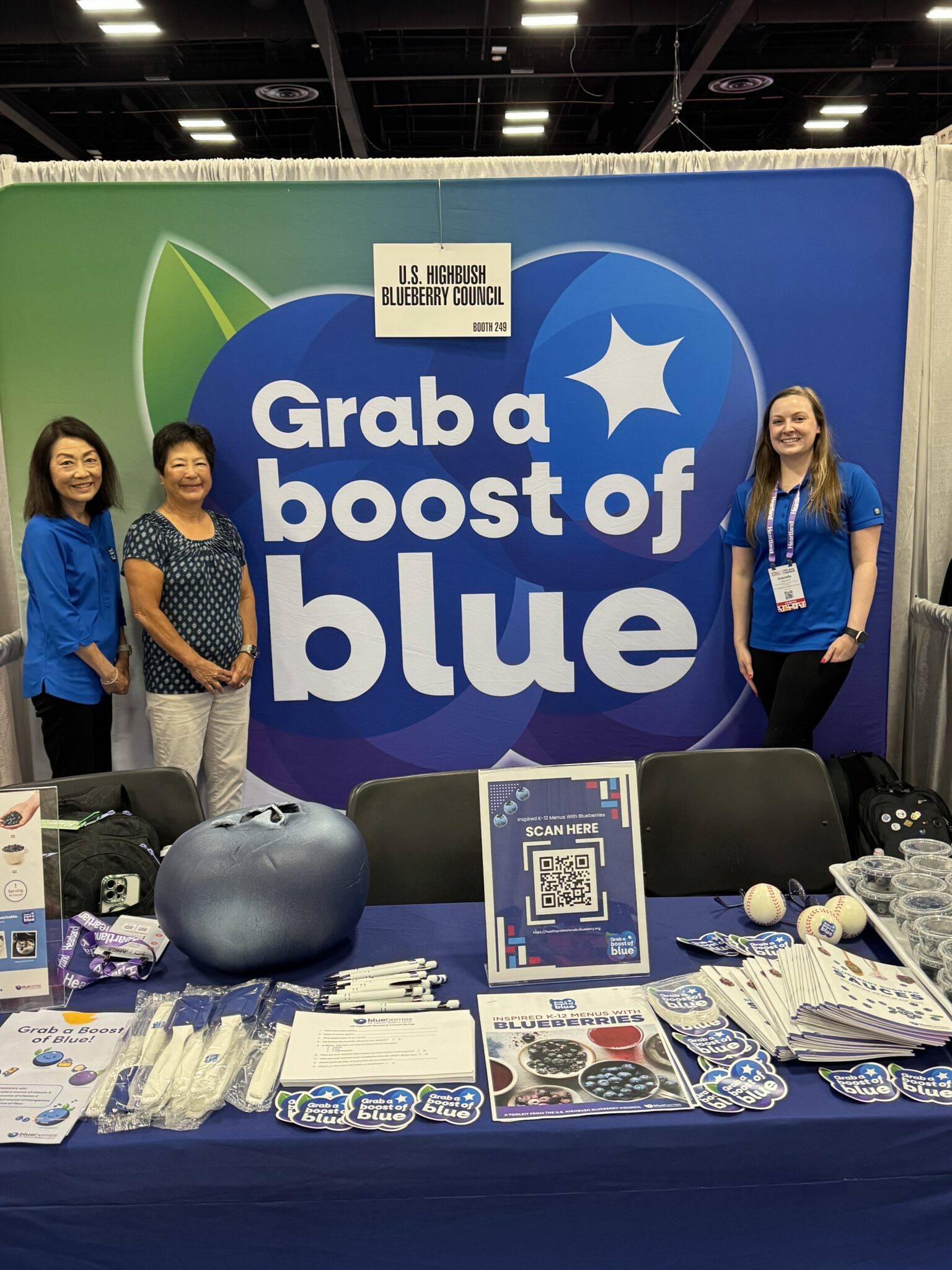
A team from USHBC attended the School Nutrition Association’s Annual National Conference in San Antonio earlier this month.
The event allowed USHBC to connect with school nutrition professionals from across the country, sharing how blueberries can help schools meet their nutrition goals and get kids excited about healthy choices.
Attendees learned how blueberries are a versatile, nutritious addition to school menus that students will love.
BerrySmart Fields Days Highlight Industry Innovation
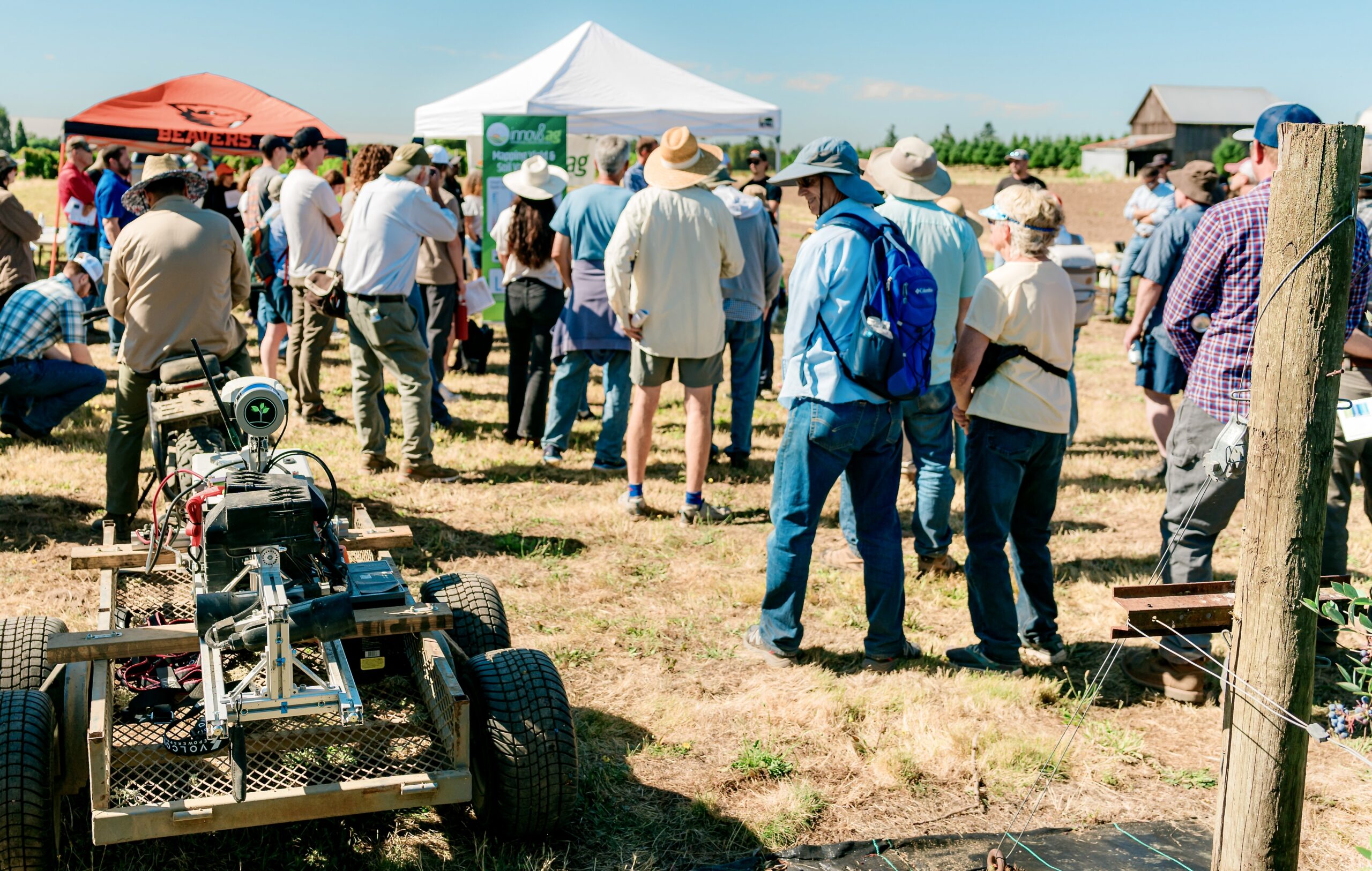
The 2025 BerrySmart Fields programs have been in full swing since spring, with on-the-ground field days in New Jersey, Washington and — happening this week — Oregon.
Focused on soil health, yield distribution, weather impacts, irrigation and labor, Steve Mantle, CEO and founder of Innov8.ag, partners with USHBC on the BerrySmart Fields program to bring the latest and greatest tech innovations and insights to blueberry growers.
The BerrySmart Fields Days highlight these innovations through collaborative, regionally located demonstration days featuring researchers and tech providers. These events allow growers to “see for themselves” blueberry tech in action, speak with the researchers spearheading the latest in blueberry science and ask questions directly.
If you missed out, there’s still one more BerrySmart Fields Day coming up this year — August 6, in Mount Vernon, Washington. Or catch Mantle at The Blueberry Convention in October where he’ll be presenting insights and takeaways on this season’s BerrySmart Fields Days.
MRL Quick Reference Sheets Now Available to Assist American Produce Exporters

The U.S. Department of Agriculture’s Foreign Agricultural Service (FAS) has launched a new resource to support American farmers’ access to international trade opportunities. Maximum Residue Limit Quick Reference Sheets provide information about pesticide residue requirements in major export markets for U.S. producers and shippers of fruit, vegetables, nuts, pulses and other horticultural crops.
FAS developed the MRL Quick Reference Sheets in partnership with Bryant Christie Inc. FAS will update these sheets every six months and will cover 60 different specialty crop commodities. MRL Quick Reference Sheets are free, easily accessible and downloadable for American farmers and businesses.
Through the Assisting Specialty Crop Exports Initiative, USDA is developing resources to help American produce and nut exporters understand and meet foreign regulatory requirements to access new export market opportunities, as well as address trade barriers in foreign markets.
Pesticide maximum residue limits (MRLs), also referred to as “pesticide tolerances,” are set by governments and are nonharmful amounts of pesticide residues that may remain on or in a food product when a pesticide is used according to label directions. MRLs vary by country and can be complex to track. FAS offers a number of programs and resources to support U.S. exporters with this issue, including engagement with foreign governments to resolve MRL trade barriers.
For more information about resources for U.S. exporters of fruits, vegetables, tree nuts, pulses and other specialty crops, visit fas.usda.gov/programs/assisting-specialty-crop-exports-asce-initiative
4 Reasons The Blueberry Convention Is Not to be Missed!

The Blueberry Convention, October 8-10 in Seattle, is going to be action-packed! You’ll want to be there to explore cutting-edge technologies and groundbreaking advancements shaping the future of the blueberry industry.
Here are four more reasons you simply can’t afford to miss out!
- Inspiring keynotes that will help you innovate, think differently and understand the market.
- The day-long Blueberry Farm Tour: A Taste of Washington’s Finest.
- The Blueberry Boost Accelerator pitch competition where startups will share their pitch and showcase their product during a “Shark Tank-style” competition.
- The NABC & USHBC Reception and Awards Dinner where we’ll honor industry luminaries – and hand out the first Elizabeth White Award.
Register now, while early-bird pricing is still available! And don’t forget to reserve your room in our discounted housing block ASAP.
Leadership Class Spotlight: Meet Sergio Carrasco

Class 3 of the Blueberry Industry Leadership Program is in full swing, and we’re excited to introduce you to a fellow from the class each month in Behind the Blue.
Sergio Carrasco was born in Santiago, Chile, and his story with the agriculture world begins with his decision to study Agronomy at Universidad Mayor in Santiago.
With about nine years of experience in the produce business, five of which were in the blueberry industry, Carrasco started as a quality control inspector for a Chilean company with operations in the U.S. A few years later, he was contracted by Eastern Propak to be the head of quality, and was then charged with overseeing the organization’s new blueberry packing house operation.
Now based in Hammonton, New Jersey, Carrasco is currently working as a production manager for The Fruitist Company where he says he assists in many areas as possible in order to keep growing, learning and advancing his career.