


For Exporters
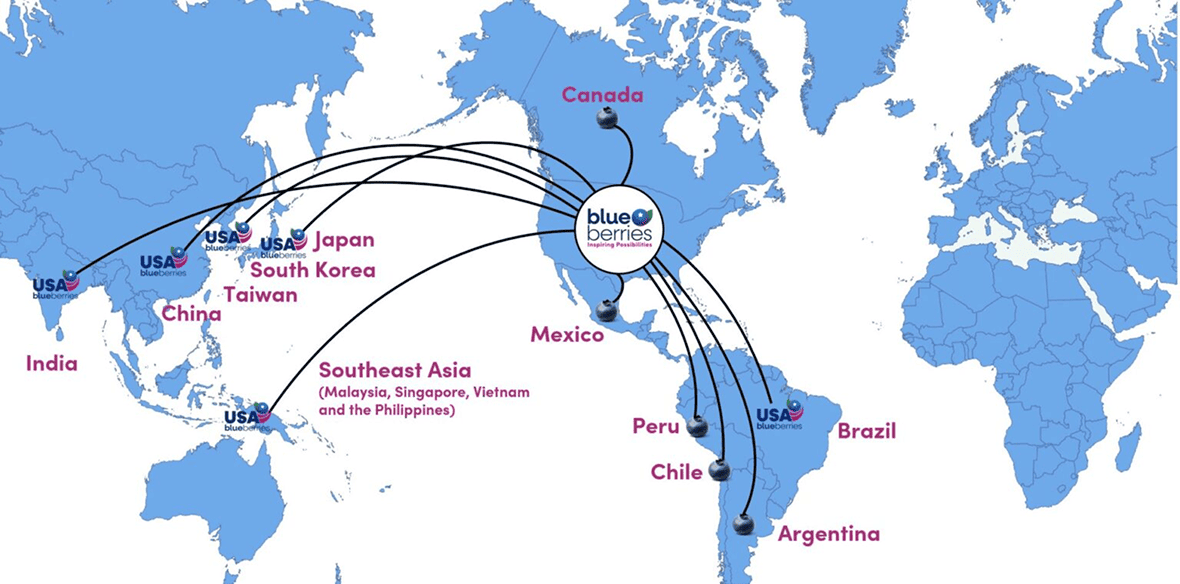
USHBC’s export programs exist to help the industry more effectively export and market all forms of blueberries in countries and regions with the highest volume potential.USHBC works with trade entities, government authorities and the industry to inspire possibilities and move blueberry volume in new markets.
Global Market Development
USHBC does extensive work to drive demand for U.S. highbush blueberries with consumers, foodservice operators, food manufacturers and retailers around the world. In addition to technical export assistance, we conduct in-country market research and promotional programs. If you’re exporting or planning to export your blueberries, we’re your partner.
Our Export Database has complete international market data for all the markets USHBC has opened over the years, including information on trade agreements and regulations.
2026 International Blueberry MRL Information
The 2026 International Blueberry MRL Memo and Database, and supplemental “Stoplight Chart” and guidance, are intended to provide blueberry growers and shippers with relevant information on blueberry MRLs in key export markets.
The International Blueberry MRL Memo and MRL Database, prepared by our partner Bryant Christie Inc., contains the following information:
- Data from the U.S. Monitoring Residue Program and Pesticide Residue Screening Program in key markets.
- Pesticides and markets for which available residue data suggests the possibility of MRL violations.
- The MRL status of pesticides registered for use on blueberries in key markets.
The stoplight charts and accompanying guidance, prepared by Synergistic Labs, are intended to aid blueberry growers who plan to export to specific markets in selecting materials to manage key pests close to harvest.
USA Blueberries Export Brand
Our new export brand for USA Blueberries was created to raise awareness of the quality and food safety assurance of U.S. grown blueberries. Contact Gabriella
Gebhardt at [email protected] if you’d like to use it on your exported blueberries – it’s free!
Export Market Opportunities

Brazil
There is growing interest from Brazilian companies in frozen, dried and pureed blueberries. In 2019, the U.S.was the second largest source of imported dried blueberries,and USHBC’s work supports Brazilian companies in formulating products with processed U.S. blueberries.

Chile
In December 2020, the U.S. blueberry industry secured market access to Chile for fresh blueberries from the states of California, Oregon, and Washington. The industry is now working with APHIS to expand access to additional U.S. states.

China
In 2019, the U.S. was the largest known source of frozen and dried blueberry imports. After diligent efforts by the USHBC and other U.S. trade entities, U.S. fresh blueberries were granted market access to China in 2020.
Download Operational Guidelines

India
India’s large population and the growing popularity and imports of blueberries make it a key market for USHBC. Ongoing efforts include work to connect U.S. blueberry suppliers with buyers in all market categories (food manufacturing, retail and foodservice).

Japan
Japan is a long-standing target market for the U.S.highbush blueberry industry. Since January 1, 2020, freshand dried U.S. blueberries enter Japan duty-free under theU.S.-Japan Trade Agreement (USJTA). [NOTE: live site copy reads “There is growing interest from Brazilian companies in Japan is a long-standing target market…

Korea
Tariffs on U.S. blueberries entering Korea reached zero as of January 1, 2021 under the U.S.-Korea Free Trade Agreement (KORUS). USHBC has targeted the Korean blueberry market with promotions for in-store and online retail, and awareness efforts touting blueberry health benefits.

South Africa
In August 2025, the U.S. blueberry industry secured access for fresh blueberries to South Africa. Facility registration is required. There are separate operational work plans for western states and eastern states.

The Philippines
A new and growing market opportunity for fresh U.S.blueberries, USHBC and U.S. trade entities supported U.S.fresh blueberries gaining market access to the Philippines in May 2020.

Vietnam
In February 2019, U.S. fresh blueberries were granted market access to Vietnam and accounted for 60% of the Vietnamese fresh blueberry market in the first shipping season.
Download Operational Guidelines
Other Export Resources
Arrival Inspection Record Form
The Arrival Inspection Record Form shows proof of monitoring production fields for the presence of larvae in fruit. This documentation is required for shipping to China (from California, Oregon and Washington), the Philippines and Vietnam.
Arrival Inspection Record Form
USDA MRL Resources
USDA’s MRL Quick Reference Sheets provide information about pesticide MRL limits in major export markets updated every six months.
All U.S.-based entities can access the latest specialty crop MRLs in 50 top countries/markets through the FoodChainID Regulatory Limits database for free, funded through support from the USDA Assisting Specialty Crop Exports initiative.
Residue Decline Curve Study
The U.S. Highbush Blueberry Council (USHBC) has collaborated with Oregon State University, Michigan StateUniversity, AG Metrics Group, and Synergistic PesticideLaboratory, LLC to establish residue decline curves forpesticides that have no established Maximum ResidueLimits (MRL) and MRLs are lower than U.S. tolerances.As a result of this research study, several insecticides and fungicides can be applied to blueberries for export markets that could not have been used previously
Global US Blueberry Export Opportunity Assessment Report
Optimize your international market strategy with this comprehensive report. Backed by Euro monitor’s data, government statistics, and interviews with key exporters, we identify top markets for US Blueberry exports. Discover market priorities, and potential for fresh, frozen, and dried blueberries, including an actionable SWOT analysis. Gain valuable insights in retail, food service, and food manufacturing channels. Strategically focus your promotional efforts and drive global demand for US Blueberries using our Prioritization Scorecard and market analysis.
Export Market Registration for the 2027 Shipping Season
Companies that plan to export to Vietnam, the Philippines, China, Chile or South Africa in 2027 must register their packing facilities. Please complete the form below or update your facility registration information with USHBC. Registration is required annually and closes on Friday, Dec. 18. If you register a new facility, USDA’s Animal and Plant Health Inspection Service (APHIS) will contact you to confirm approval. Have questions? Email NABC Senior Director of Government Affairs and Public Policy Alyssa Houtby at [email protected].
Universal Export Registration Form
